
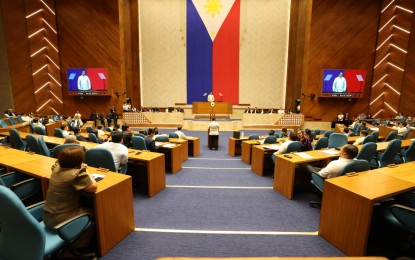
THE House of Representatives on Wednesday approved on second reading a landmark bill prohibiting political dynasties and promoting equal access to public office, in line with the mandate of the 1987 Constitution.
House Bill No. 8389, or the proposed Anti-Political Dynasty Act, which bars relatives within the second degree of consanguinity or affinity from running for or holding office in the same locality, was approved through viva voce voting by lawmakers.
Speaker Faustino “Bojie” G. Dy III and Majority Leader Ferdinand Alexander “Sandro” A. Marcos are the principal authors of the measure, which has 173 other lawmakers as co-authors.
The broad backing reflects strong support within Congress for long-awaited legislation addressing political dynasties, which has been identified as a priority measure under the Legislative-Executive Development Advisory Council (LEDAC) and endorsed by President Ferdinand R. Marcos Jr..
The approval came more than two weeks after Speaker Dy reiterated the significance of passing of the measure at the resumption of congressional session, saying the bill is critical to strengthening public trust in government.
“Kung tunay nating nais palakasin ang tiwala ng taumbayan sa ating institusyon, ipasa na natin ang Anti-Political Dynasty Bill,” Dy told his fellow House lawmakers.
The measure was approved by the House plenary on second reading following the recommendation of the House Committee on Suffrage and Electoral Reforms chaired by Lanao del Sur 1st District Rep. Zia Alonto Adiong, which consolidated 17 related proposals into the substitute bill.
The second-degree coverage reflects consultations across Luzon, Visayas and Mindanao, where stakeholders raised both support and concerns about implementation.
Article II, Section 26 of the 1987 Constitution directs the State to prohibit political dynasties as may be defined by law, but Congress has never enacted an enabling statute.
In sponsoring the measure, Alonto Adiong said the substitute bill was crafted after extensive consultations nationwide and careful consideration of legal, constitutional and practical concerns surrounding the regulation of political dynasties.
He stressed during plenary debates that the second-degree limitation was adopted to ensure the measure remains enforceable and reasonable, noting that broader prohibitions could create serious administrative burdens for the Commission on Elections (Comelec).
Alonto Adiong also emphasized that the bill does not permanently disqualify individuals from seeking public office, but merely regulates simultaneous or successive concentration of elective positions within the same locality among close relatives.
During interpellations, lawmakers discussed the constitutional basis of the measure, its impact on local political structures, enforcement mechanisms for the Comelec, and safeguards to protect the right to seek elective office while upholding the Constitution’s clear directive against political dynasties.
Under the bill, a political dynasty is defined as the concentration, consolidation or dominance of elective political power by spouses or relatives within the second degree of consanguinity or affinity.
The measure prohibits spouses or relatives within the second degree from simultaneously holding or running for elective posts in the same national, provincial, city, municipal or barangay government, or from seeking seats in the House of Representatives within the same legislative district.
The proposed law will apply beginning in the next elections once enacted.
The bill also requires candidates for elective office to submit a sworn statement to the Comelec declaring that their candidacy will not result in a prohibited dynastic relationship.
If relatives file candidacies that could create a prohibited dynasty, the bill provides a mechanism for resolving the situation, including voluntary withdrawal or the drawing of lots if the concerned parties fail to agree who among them may assume office.
The measure further directs the Comelec to issue implementing rules and regulations within 90 days from the law’s effectivity.
If enacted, the proposal would establish the first comprehensive statutory definition and prohibition of political dynasties since the ratification of the Constitution in 1987.
 IMPEACHMENT COURT GIVES VP DUTERTE UNTIL JUNE 1 TO ANSWER SUMMONS
  ICC ARREST WARRANT VS SEN. BATO VALID AFTER SC DENIES TRO – PALACE
  ‘THERE WAS NO ATTACK ON THE SENATE’– REMULLA
  HOUSE PANEL OKAYS HAZARD PAY FOR WEST PH SEA PERSONNEL
  8,700 BARANGAYS SERVED SINCE ROLLOUT OF ‘BAWAT BAYAN MAKIKINABANG’
  HOUSE TO PROBE NGCP OVER MASSIVE LUZON-VISAYAS BROWNOUTS
  MAN TAKES WIFE HOSTAGE IN BATAAN